CLAES, COOSJE & ME
a travelogue, a rendezvous, and a critique
A journey to the highbrow play land of Claes Oldenburg & Coosje van Bruggen
Sculpture: La Bicyclette Enselvie Sculpture
Where: Parc de la Villette, Paris
Installed: 1990
Visited: June 19, 2019
Met: Marine Freychet
Blog Entry: 1st, July 24, 2019
We met Marine at Park Villette on June 19, 11:41 a.m., per the timestamp on the photo I took of her and Maddy and Barb, which I snapped less than a minute later. I wanted, you see, to capture the mirthful initial meeting, but they saw me and smiled at me and the candid moment was lost. Marine is in the middle.
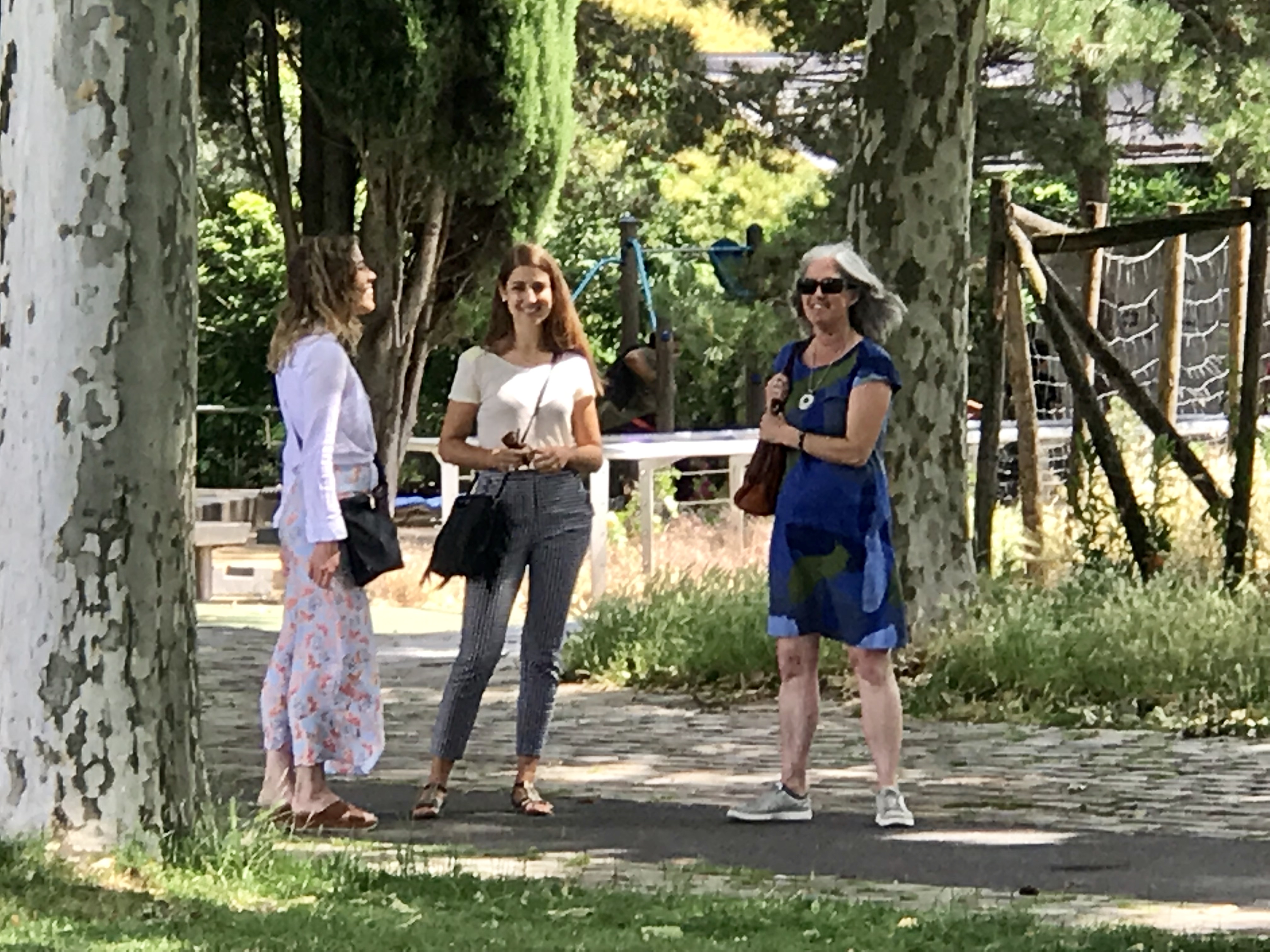
Having ditched fifty-two 18-year-old high school students we were commandeering through a three-week European Dream 2019 tour, we were to meet Marine on her two-hour lunch break. This was my sixteenth straight year taking students to Europe, Barb’s eighth year, and Maddy’s first, although she went with her high school class—with her dad as tour leader back when she was a graduating senior.
Why were we all taking separate metro rides to meet in Park Villette, which is a great distance from the heart of Paris? It was all because of Claes Oldenburg and Coosje van Bruggen, the radical pop art married masters of blowing up ordinary objects into monumental forms. I have been a fan since I saw my first soft-sculpture of theirs, a giant three-way electrical wall plug, hanging from the ceiling of The Walker Art Center’s entrance foyer in 1982. (It’s now been moved to the stairs, after a major Walker redesign—and it seems misplaced)
We were a bit late for this 11:30 rendezvous, having taken the Metro from our hotel in the Latin Quarter and underestimating how large the park was. Initially, we couldn’t find “Buried Bicycle,” but I was quite sure we were headed in the right direction, and with Google Maps fading—data roaming turned off—anxiety consumed us. Well, me. I hate being late, and yet I am often late—usually just a few minutes, if it’s any consolation. I am, by constitution, self-conscious and worry about what people think, and, as that day’s navigation-leader, the speed-walking steps I took, might have seen comical to an onlooker: me, Barb 20 steps behind, Maddy 40 steps back.
It occurs to me now, that this adventure was so de rigueur Parisian. It’s like looking for a Paris bistro that locals say is ‘can’t miss,’ even though it’s around a secret Place, down a narrow street, through a courtyard, and behind a hidden door.
Ironically, Parc de la Villette is vast open spaces, and was notoriously designed by the deconstruction theorist Bernard Tschumi in the mid-1980s to disorient park enthusiasts. The word he used was defamiliarization—he wanted a park without referencing traditional parks—where order and pathways lead visitors to certain landmarks. Many disliked it originally, but, like the Eiffel Tower, the Pompidou, and the glass-diamond entrance to the Louvre, they now embrace it—especially with the 2015 edition of Jean Nouvel’s magnifique Philharmonie de Paris.
After circumnavigating the massive and cube-modern City of Science and Industry with its glistening La Geode, I spotted a horizontally-spreading, but low-rising bike-tire-with-rain-guard structure in the tree section. Fait accompli.
A lengthy canal, however, separated us from the spoke-y sculpture. And the bridge-over was way down there. More logistical stress.
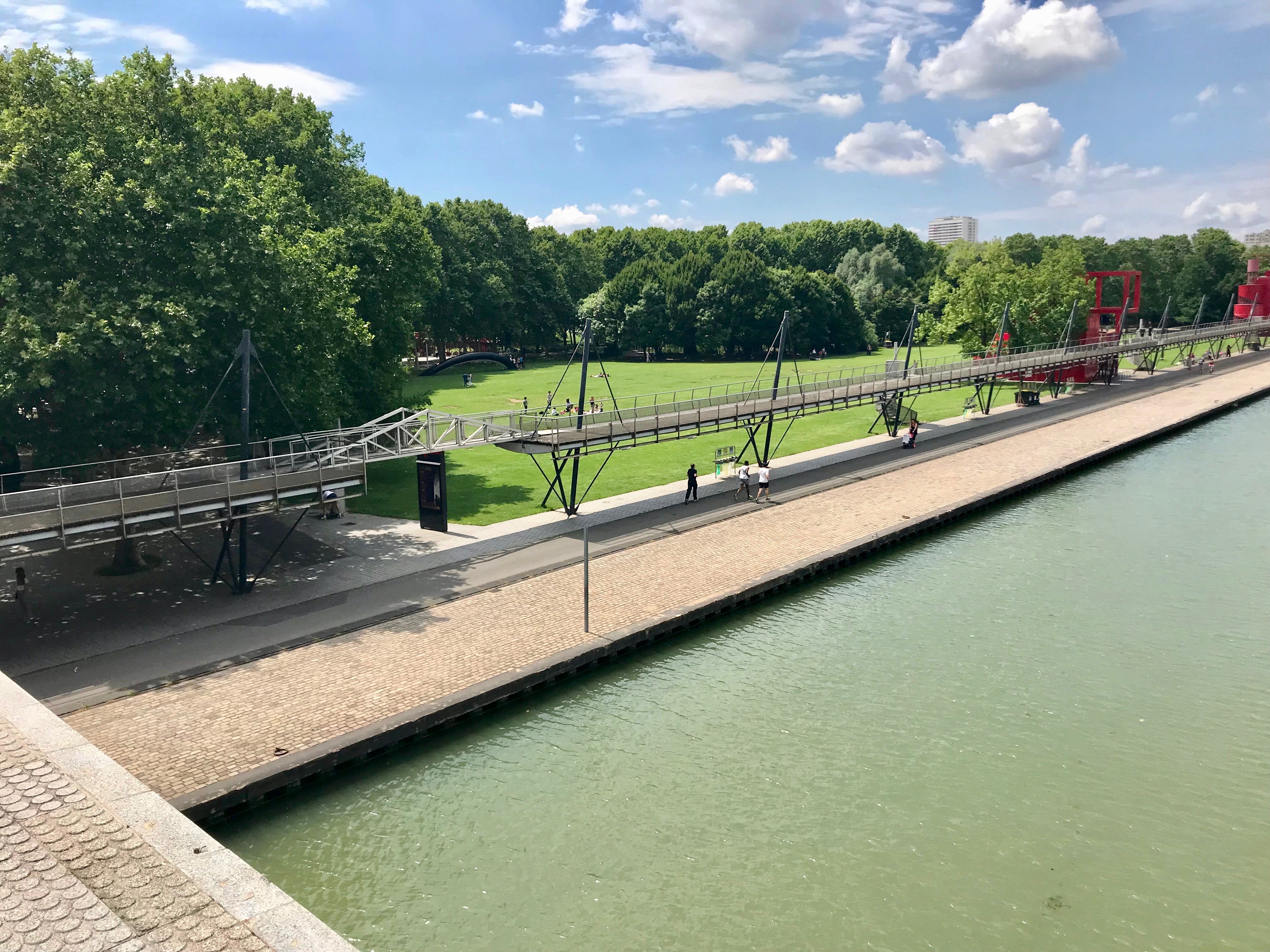
As we crossed the pedestrian bridge, I was of two minds: looking for Marine and the sculpture.
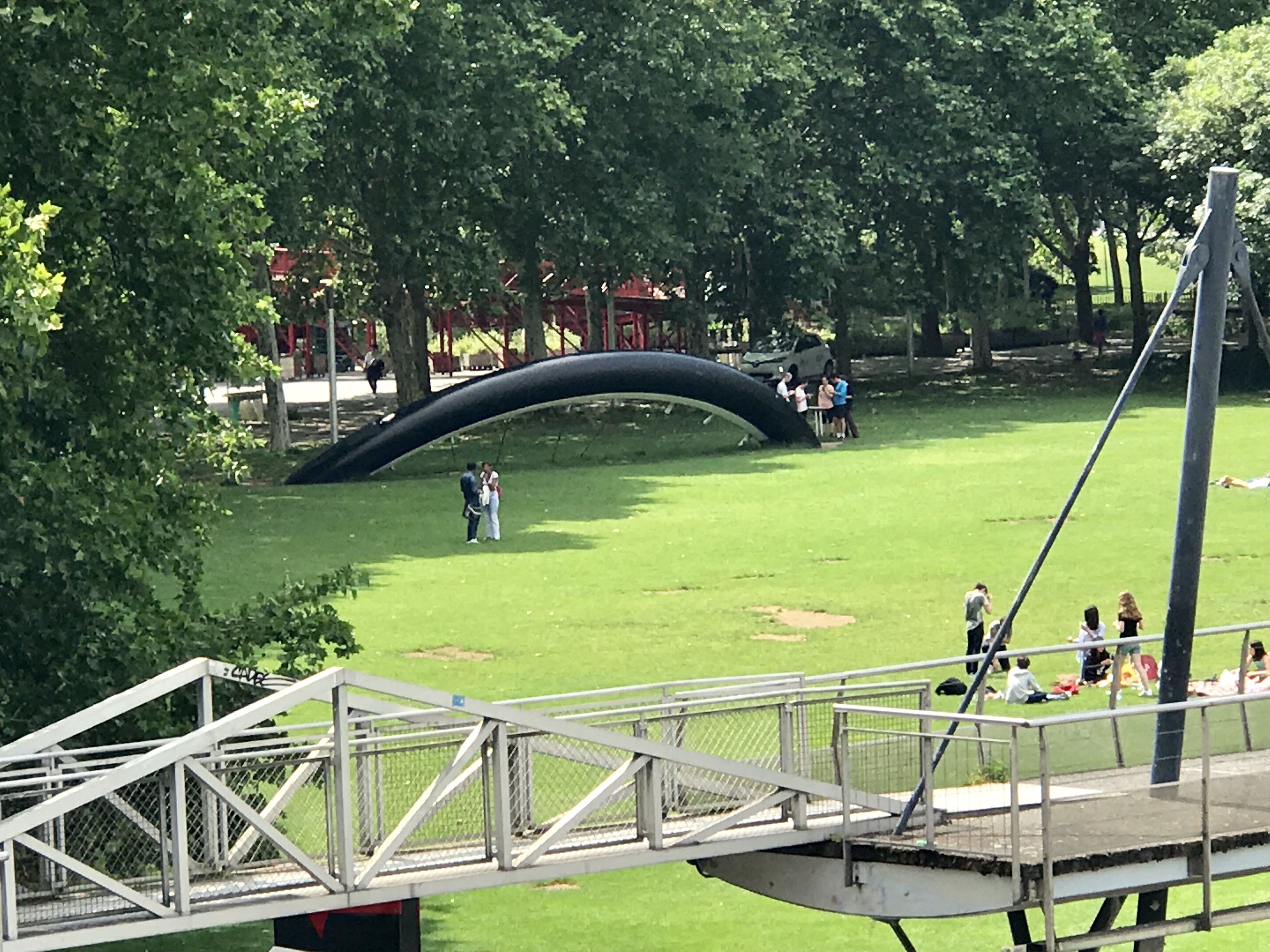
From up high I could see more of the sculpture — “ooh, there’s one handle bar sticking up and there’s a foot peddle down the way.” And now my mind split again: Do I want to take a picture here or capture a video of Maddy and Marine meeting up again after all these years. It’s not often one can get a bird’s eye view of a ClaesCoo sculpture. But, with their creations, multiple points of view are essential to unlocking new meanings. So, as I stopped on the bridge to take a couple quick pictures, Barb and Maddy, now together, passed me.
(The first view of a ClaesCoo sculpture is always a thrill partly because of the quest taken. As hinted at earlier, each one is a bit of a treasure hunt. A few months earlier, Barb and I were visiting her sister Anne and husband Steve in Connecticut, and the four of us were driving around the PepsiCo Sculpture Gardens—as big as a golf course, but with more trees. I remember pointing while telling Steve, “Let’s park here, because the giant Trowel is supposed to be over there in that clump—but who knows.”)
I wondered for a second how proportionally accurate the bike was—I couldn’t see the seat from the bridge. Trees obscured it. I motivated along, start, stop click; start, stop, click.
As I scurried to the end of the bridge, there the three of them were, chatting and laughing.
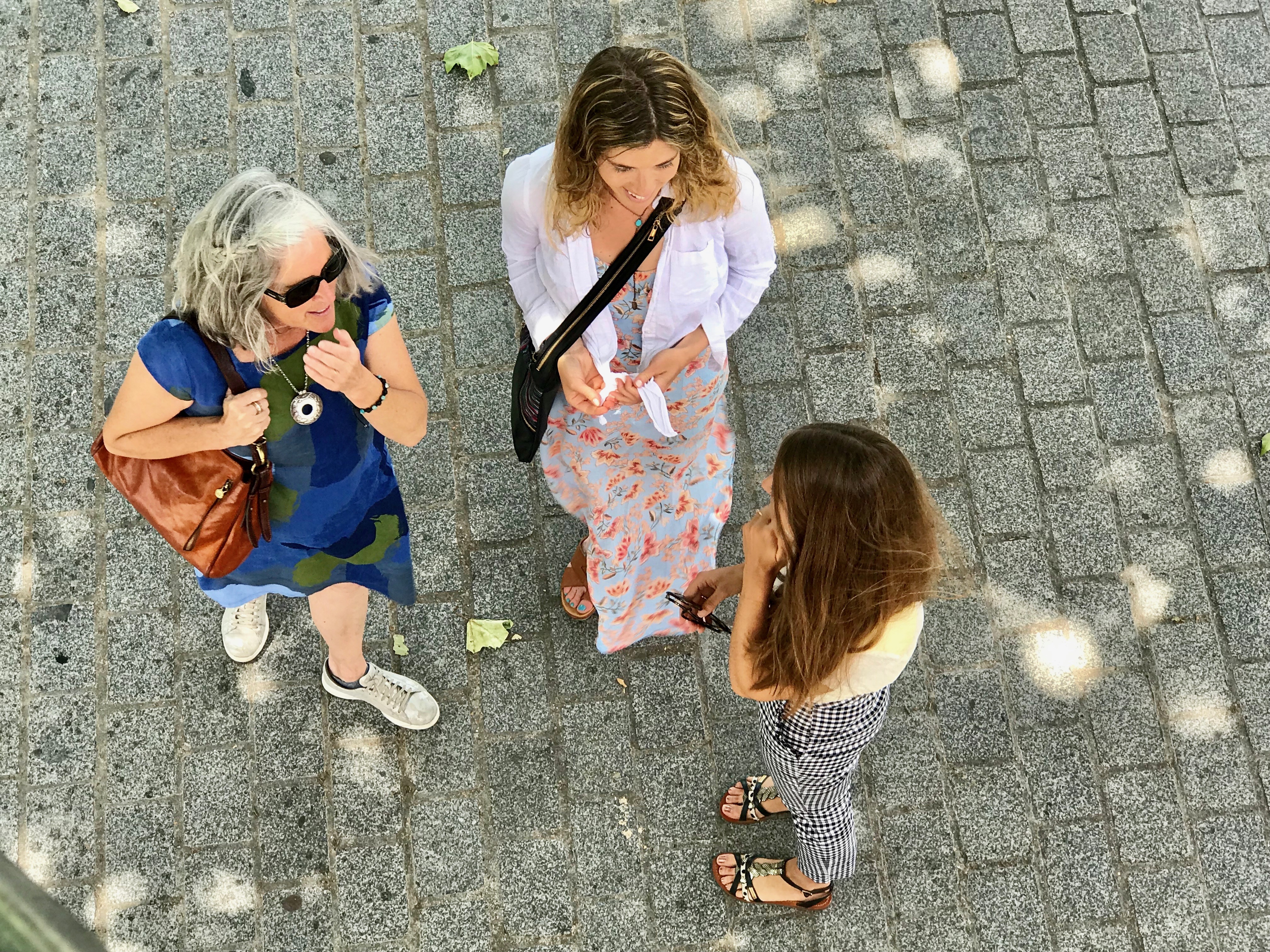
Marine Freychet: Parisian by-way-of-Nice, age 30, looking as lovely and relaxed and self-composed as I remembered her when she and Maddy were exchange students thirteen years ago. I guess a video would have been too precious anyway, but I do so like seeing the French-kiss-meeting of friends, and I missed that, too.
I had written to Marine a few weeks prior about my wanting her and Maddy to meet at the sculpture and briefly explained my blog idea. Since I am not an art expert, I wanted to write about Oldenburg sculptures from a lay person’s perspective. It would be part travelogue, part personal narrative, part art dissection, and part rendezvous with friends and telling their stories as much as mine.
In our two hours together that afternoon, we walked around the sculptural pieces and talked—a little bit about the sculptures, but mostly about family news on each side. We gave Maddy and Marine a little alone time, but not nearly enough to hash over the years. Maddy and Marine had briefly met for dinner in San Francisco – where Maddy lives – seven years ago;
Barb and I spent an evening with her parents, Laurent and Fabienne, Barb’s younger sister Joan and her husband Lee last summer when our student tour went through Nice.
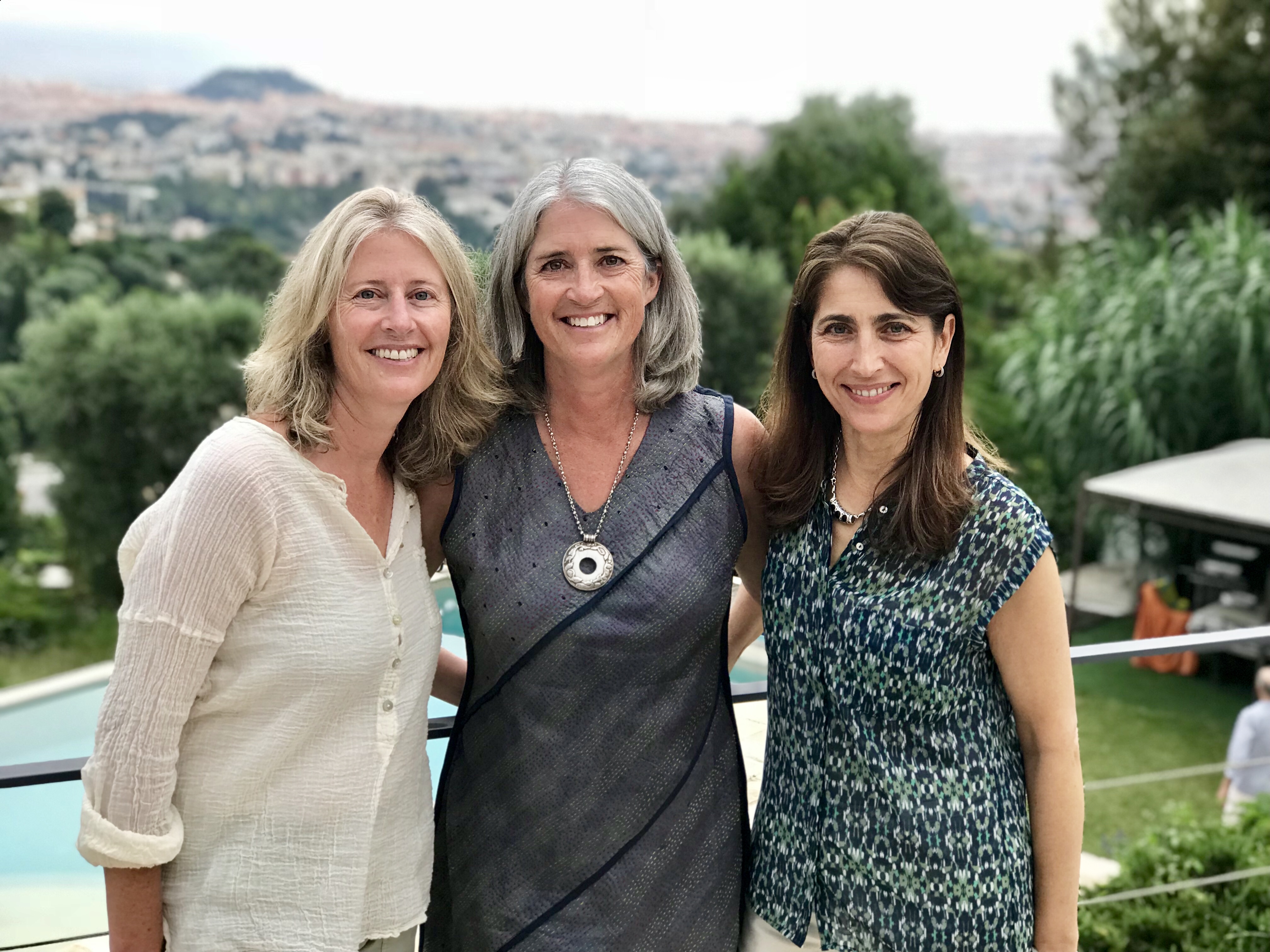
(Joan, Barb and Fabienne in Nice, summer of 2018)
We also saw the whole family in 2008 when they were building their new house on the hill, and we were doing a home exchange with a family in Barcelona.
When Barb was a sophomore in high school living in Sheboygan, Wisconsin, she joined a foreign exchange program and ended up in Corsica for the summer. The next summer, her new Corsican friend, Graziela, came to Sheboygan.
Flash forward to 2004. Barb wanted Maddy to have a similar experience, but, living in Redondo Beach, California, had trouble finding a right-fit program. That’s when Lee and Joan, living in Nashville, said, “You remember Laurent and Fabienne, from Nice, France, who came to our wedding? Their daughter wants to come to America.” It was a terrific coincidence and a life-changing exchange for both kids. Maddy went to Nice before her junior summer and Marine came to Redondo the next summer. They hit it off. Maddy had her first Nicoise salad, first stuffed tomato and ratatouille, while Marine had her first Oreo and hamburger—and it was at In-N-Out! They went to Vegas (and got upgraded to a huge double suite room), a Beck concert in L.A., and when we took her to Minneapolis, they saw The Kings of Leon, Marine reminded us, at First Avenue before they got big.
Marine went to college in Toulouse, majoring in Economics, and then came to New York City, where Steve got her an internship and later she moved to Atlanta to get her master’s degree.
Now she works for one of accounting firms’ Big Four, KPMG.
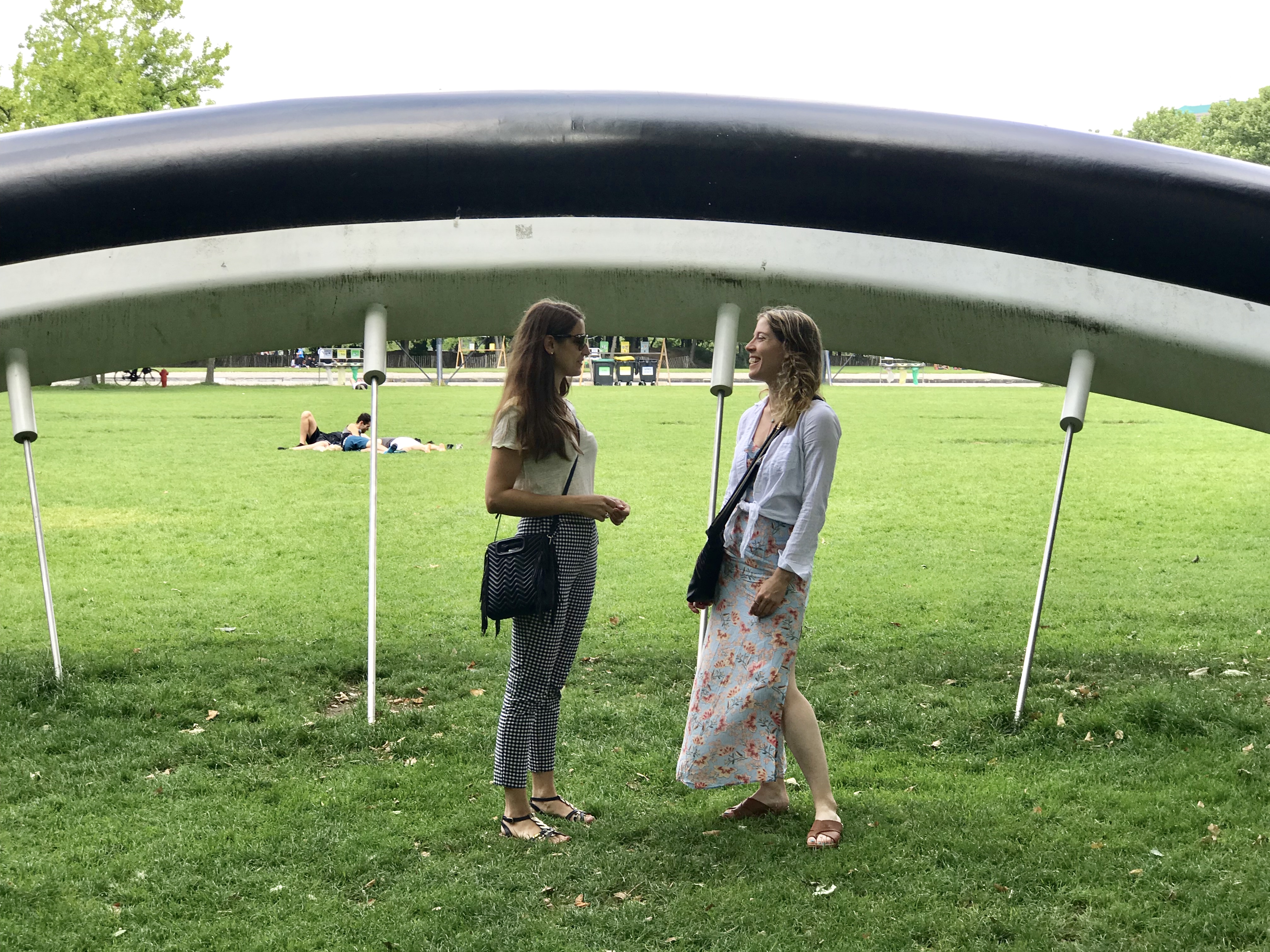
(Marine and Maddy by the bike rim)
Marine was born in Nice in 1988 to Laurent and Fabienne Freychet. A few years later her brother Roman was born. Many years earlier, Laurent’s father and mother, Pierre and Claude met Lee Gorden’s parents, Phil and Vivian in Bethesda, Maryland, in 1969 and they all became lifelong friends. Phil, unretired at age 85, still works at the National Institute of Health (NIH). It’s hard for me to keep up with all the Trans-Atlantic meet-ups the two families made over the years, but I am grateful to be tangentially included in their unique histories. Phil, for example, grew up in Oxford, Mississippi, in one of the only Jewish families in town but claims to have experienced very little discrimination there. Pierre grew up Algeria before moving to Paris—just like Albert Camus. As a high school teacher—my full-time job—I teachThe Stranger to my seniors and I must ask him what he thinks of Camus. Lee and Joan fondly remember riding in the backseat of Pierre’s blue two-door Ford Mustang in France. Serge Gainsbourg’s best song is “Ford Mustang” (bang!). “We are the children of Marx and Coca Cola,” auteur Jean-Luc Goddard famously states at the beginning of his Masculine/Femininefilm. These thoughts bivouac through my mind.
I am not sure you are following the logic of this essay, but I am attempting to upend expectations in the Bernard Tschumi-way. Or the ClaesCoo-way. Why did they blow up a bicycle? And why did they bury it? What have I buried in this essay, what have I chosen to reveal?
One answer to the former question is obvious: France invented the bicyclette and The Tour de France is the most famous bike race in the world. The bicycle figures prominently in French art and cinema. Who does not first picture the joyous bike ride by the three protagonists when Francois Truffaut’s Jules and Jimis mentioned? Or the struggle of the ascending rider, Champion, in Sylvain Chomet’s poignant animated film The Triplets of Belleville?
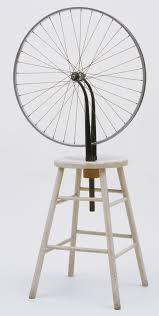
More apropos to Buried Bicycle is Marcel Duchamp’s 1915 The Bicycle Wheel, one of the most influential readymade art pieces of the 20thcentury. It’s simply an inverted bike wheel attached to a wooden kitchen stool, and it’s brilliant. There is something mesmerizing and peaceful about spinning a wheel.
Clearly, Paris needed to create a monument to the bike.
So, what’s the symbolism of burying it? Coosje said she got inspiration in a happenstance way. She was walking past Gallimard bookshop near Café de Flore in Paris, and noticed Samuel Becket’s Molloyin the window. In this 1950s novel, the boy Molloy rides his bike (to get away from it all), crashes it, loses it and then finds it buried in a bush.
In a way, the whole sculpture is buried in the corner of the park, and over the years the trees have subsumed it. The edition of kid’s climbing and spinning equipment next to it have further diminished its authority as a monumental sculpture. Or maybe that was the intent.
There is a sign—that I suspect is recent—that says:
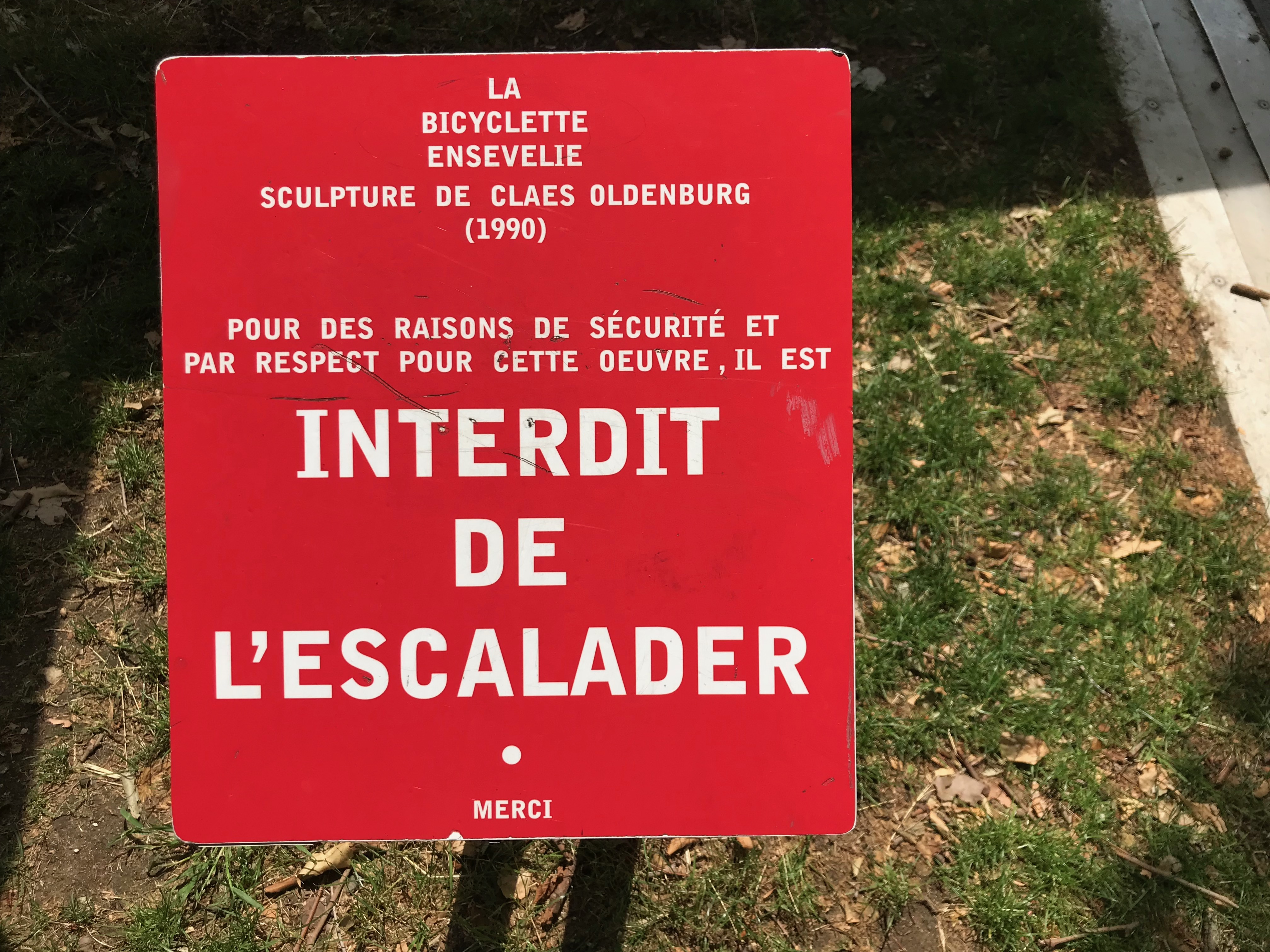
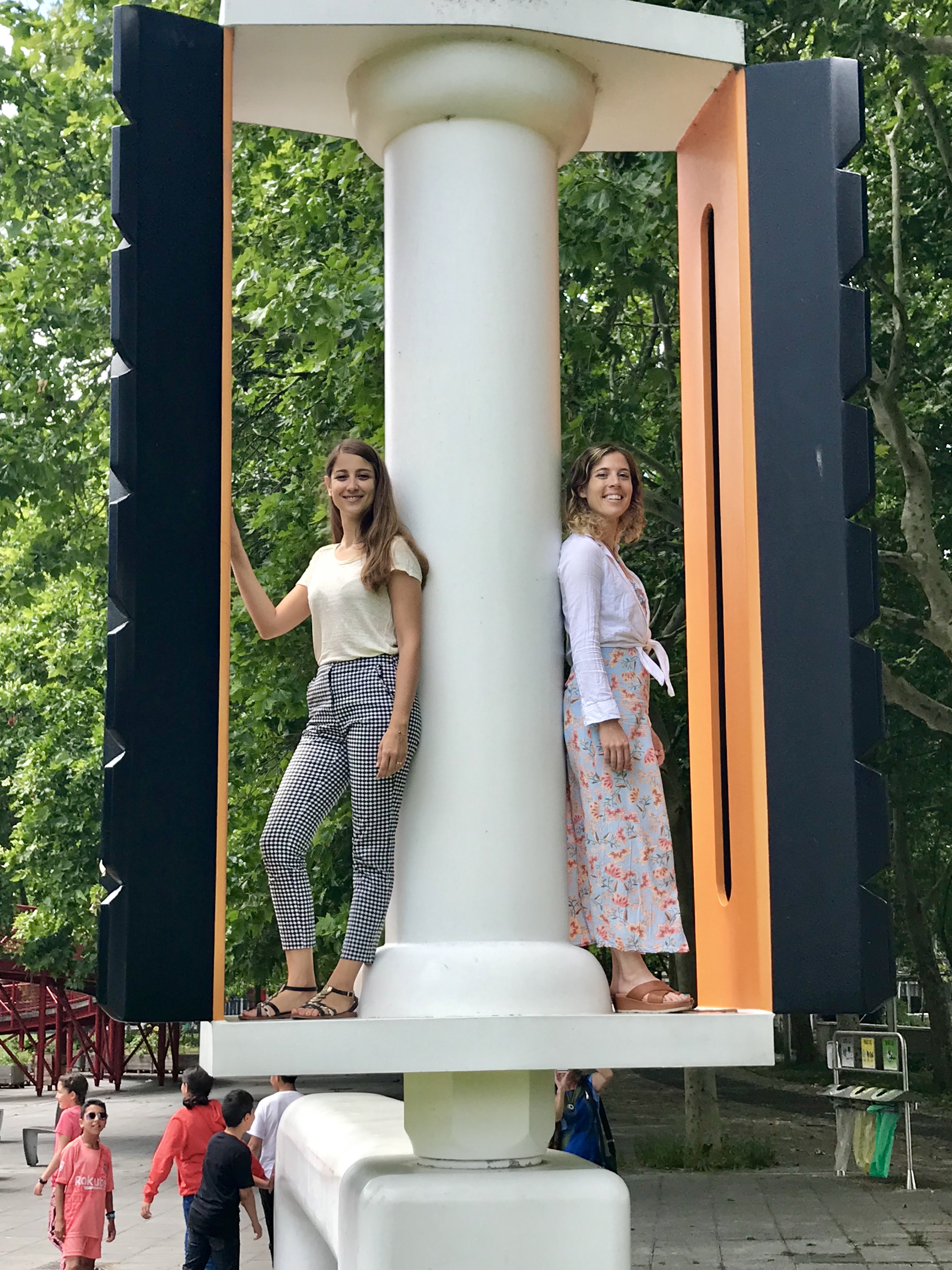
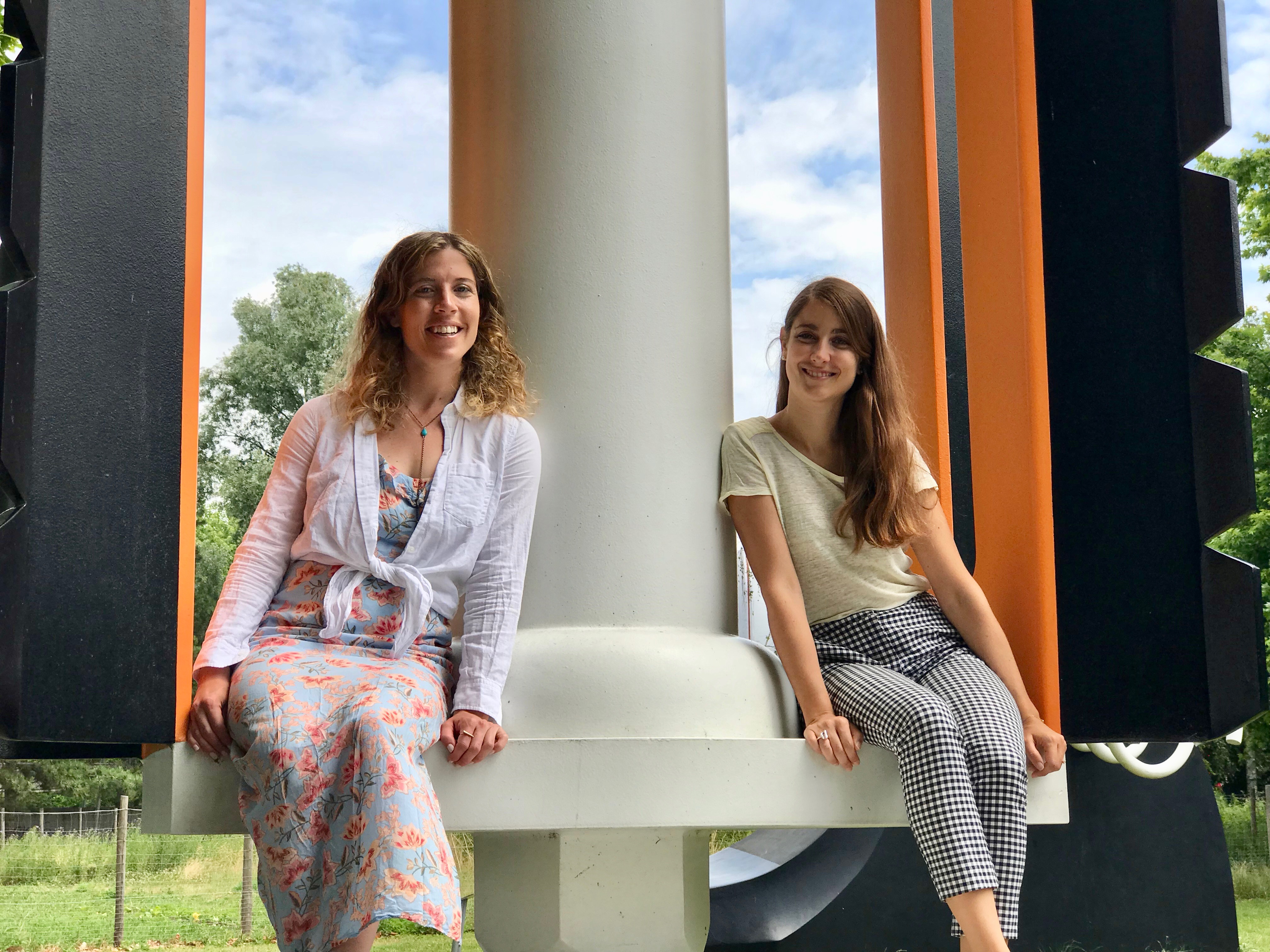
But we climbed it anyway—it’s our poetic license. And we got what all agree are the best shots of Marine and Maddy framed in a giant bike peddle. As soon as we did, 20 or so kids in a summer camp attempted to climb. Oh boy. But, it was ClaesCoo’s intent for people to climb these pieces. Did someone fall? Was there a lawsuit? This sculpture needs to be a climbing piece. That’s what you do to a bike—you mount it. Otherwise it becomes a cold, museum artifact that invites disrespect.
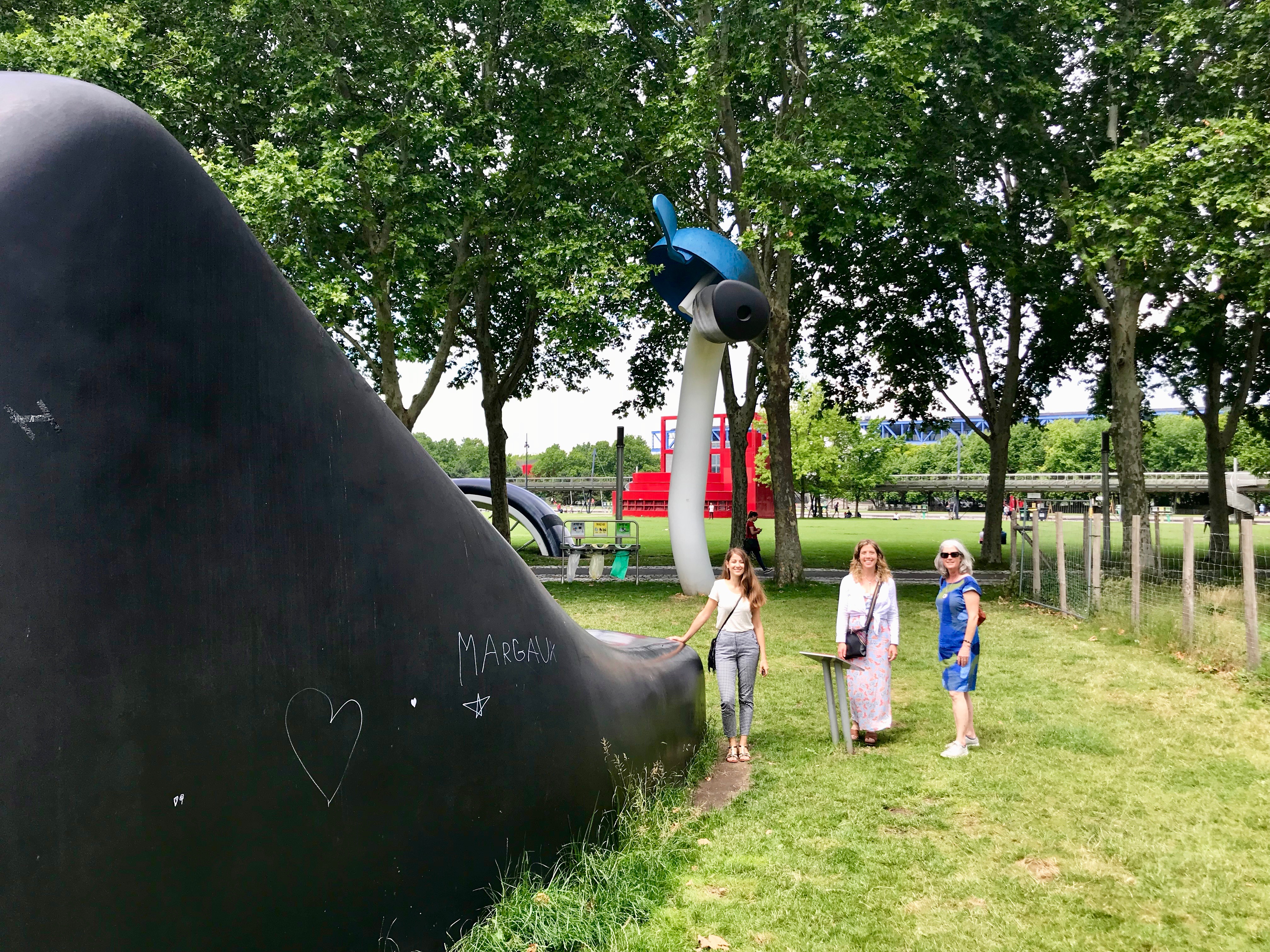
There should be another sign that says “Do not vandalize or graffiti the bike sculpture.” Because while the discovery of a bicycle buried is part of the fun—oh now I see it! —the presentation of it as an art piece—in 2019—has been compromised.
I do believe that Claes Oldenburg is about to have his moment. He is 90 years old—Coosje died in 2009—and his sketches were just sold to The Getty for $$$$. Come along on my ride and be part of the moment.
Wryly but Truly,
The Literary Vagabond
 Claes, Coosje and Me
Leave a comment