CLAES, COOSJE & ME
a travelogue, a rendezvous, and a critique
Where: Las Vegas, Nevada
Installed: 1981
Visited: Feb. 17 & July 8, 2019
Met: Sara Khattab & Tia Elpusan
Blog Entry: September 14, 2019
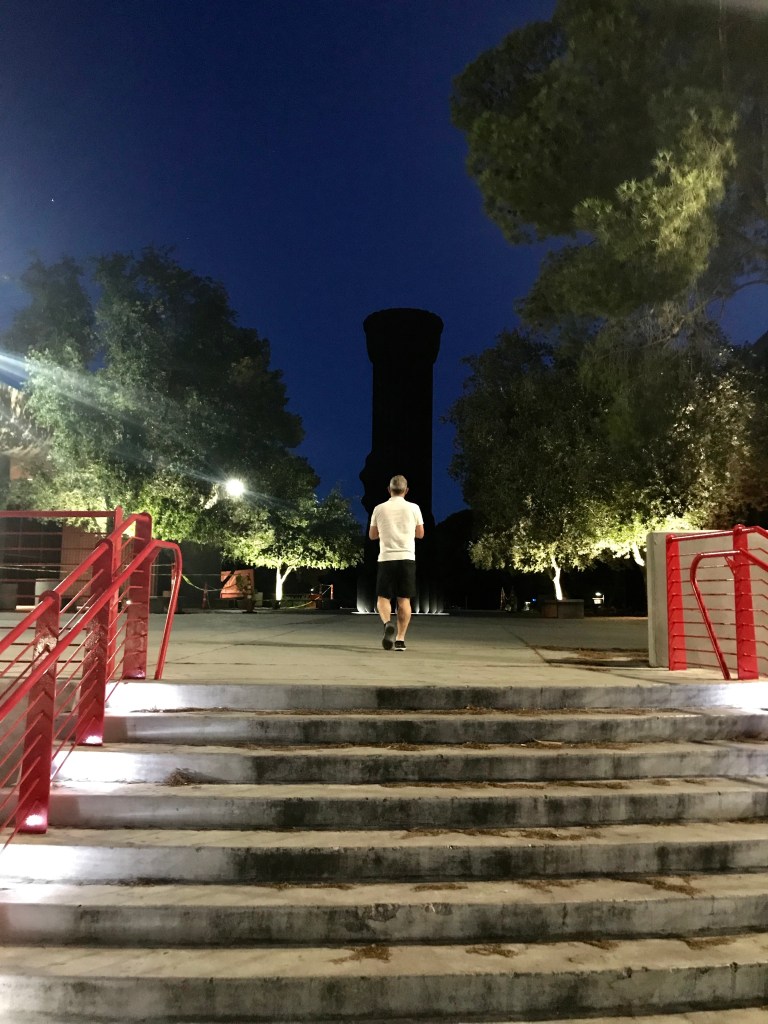
It appeared as an obelisk or megalith descended from the sky to the desert when we saw the Flashlight at dusk on the campus of UNLV one July 8th evening. It had both the patina of ancient creation and the glow of futuristic alien occupation.
Barb, our son Louis, and I had driven early from The City of Quartz across Mojave colors of mauve and burnt orange to a hotel pool of Hockney blue. And then we darted through traffic on the Strip to catch a view before nightfall. I was an anxious driver, ignoring GPS voices, taking instead dead-end right turns. I thought I knew Lost Wages, but it had been awhile. We would backdoor our way to campus.
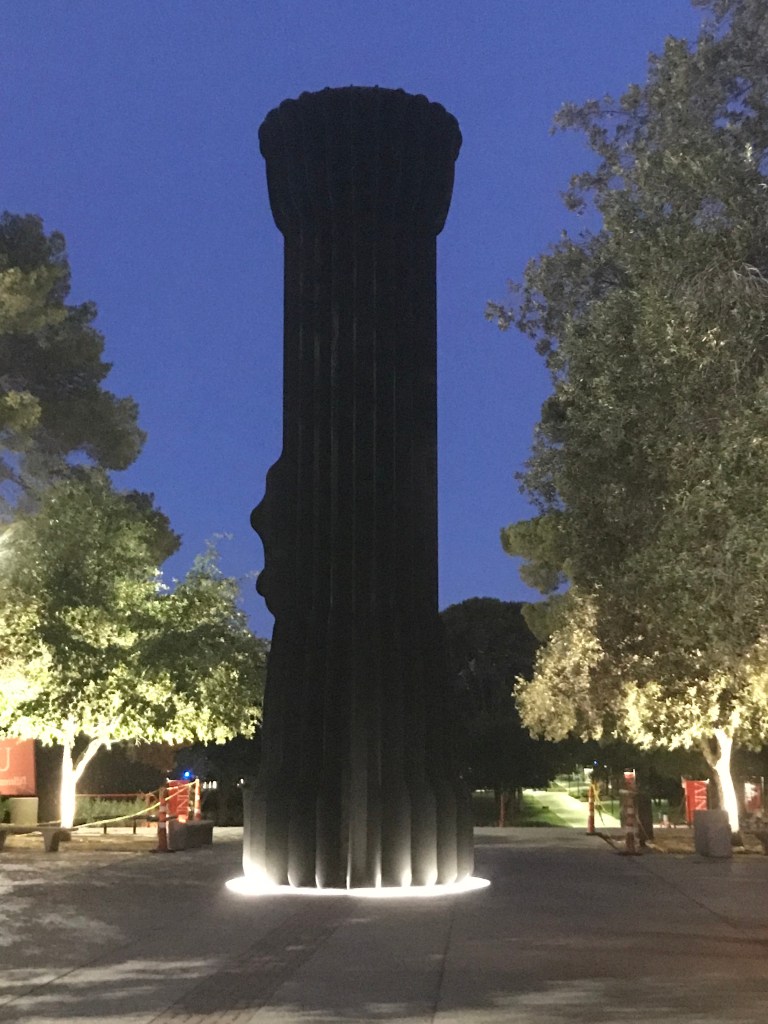
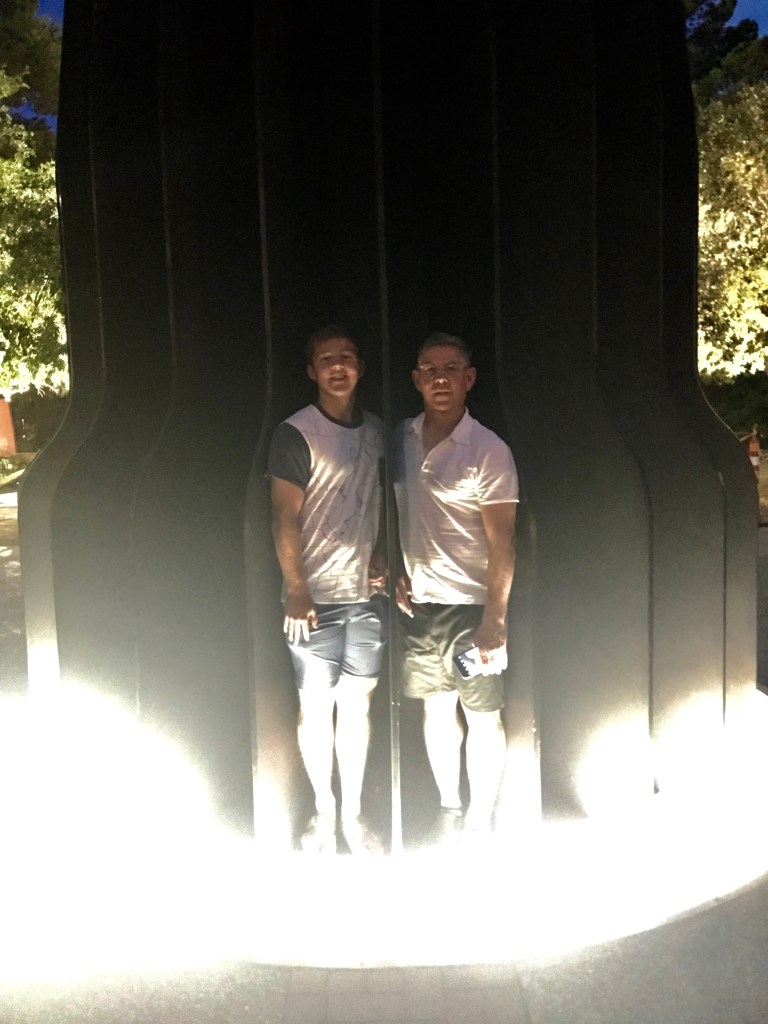
The desert twilight is a fleeting thing, but a split moment of transcendental purple found us at the Flashlight. We took some fast pictures and had a 5-minute marvel. Then everything went dark, matching the intense blackness of the steel sculpture. That was pretty much it. Contrast this with a trip to Loyola Law School I had taken a few day’s prior—that entry comes later—to see Spilled Paint, and the story the security guard told me about a European man who sat on a bench for eight hours gazing at the sculpture. I suppose both approaches are laughable—no offense, Claes.
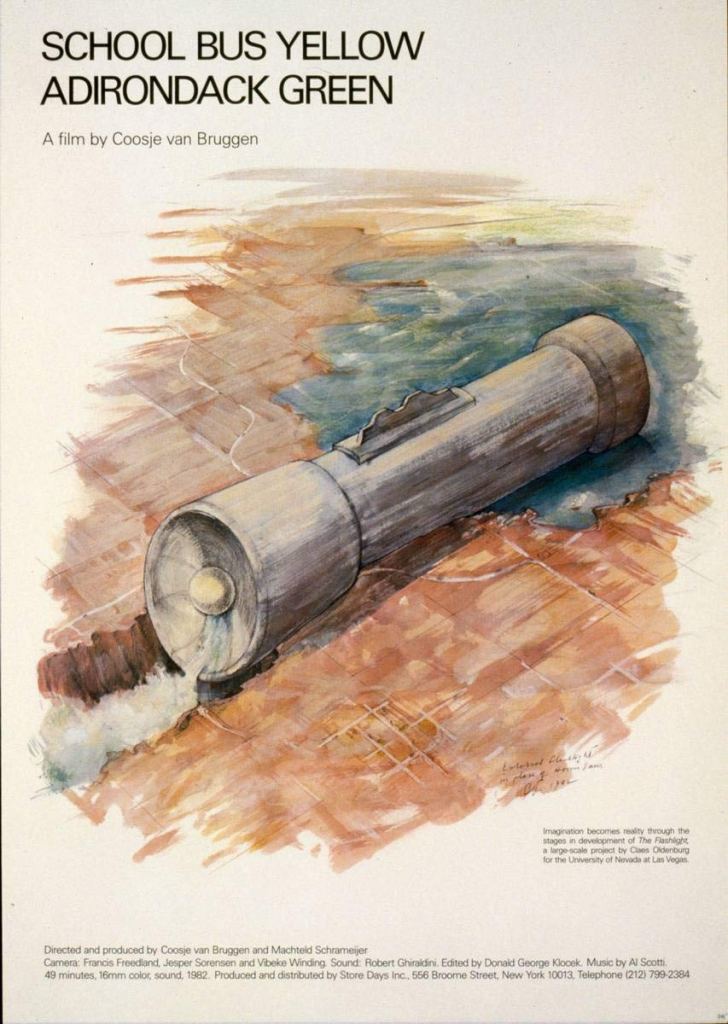
I have a poster of Coosje van Bruggen’s 49-minute documentary movie she made—School Bus Yellow, Adirondack Green—in 1982 about transporting the Flashlight from a factory in Connecticut to Nevada. (I would love to see the movie; would probably have to go to The Library of Congress to view.)
The poster—drawn by Claes in watercolor, pencil, chalk and crayon—reimagines a colossal flashlight replacing Hoover Dam. It reminds me of what I have always loved about Nevada: arid flatness and moonlike otherworldliness. To the north is Area 51 and farther up is “The Loneliest Highway in America.” How can you not be playful in form and riotous to convention in this state?
Back in the 1960’s, gaudy, giant and gauche signs dominated the Strip. Architecture critics scoffed. But two Yale professors thought otherwise:Robert Venturi and Denise Scott Brown, who resurrected the underappreciated town in their seminal 1968 book, “Learning From Las Vegas.” They proposed that Kitsch City’s iconography—signage, neon in particular—was better than Rome’s. The symbolism of arches and mosaics were bested by the quicker neon and giant arrow road signs—which matched the pace of traffic in wide open landscapes. And then buildings like the Golden Nugget became the sign. There was no elitist interpretation of form needed. Let’s take modernism off its high horse and put it on a real horse, Venturi and Brown were saying.
Today Vegas has morphed from Glitter Gulch to something universally cosmopolitan. The latest skyscrapers are less fantasy-driven and more sleek-modern. High art in the form of Maya Lin, James Turrell, and Henry Moore pepper the City Center as do Michelin-starred chefs.
Which is why Claes and Coosji’s decision to install a 38-foot high Flashlight on the campus of UNLV, two miles away from the strip was prescient. It wouldn’t have to compete.
I have had some bad luck viewing it. This past February I was driving back from Salt Lake City where I had flown, met my daughter Nora and her now-husband Dan who had driven two cars down from their home in Jackson, Wyoming. The Honda Civic they sold to Louie,—remember him from the second paragraph?—but he was busy with his sophomore year at UCLA. So I volunteered to drive the car back.
It was snowy and cold in Salt Lake, I recall. But the three of us had a fun Saturday, stopping first at Publik Coffee Roasters, then The Green Ant, a mid-century furniture store (where we had once bought a red Eames sofa) and the adjacent Ken Saunders bookstore.
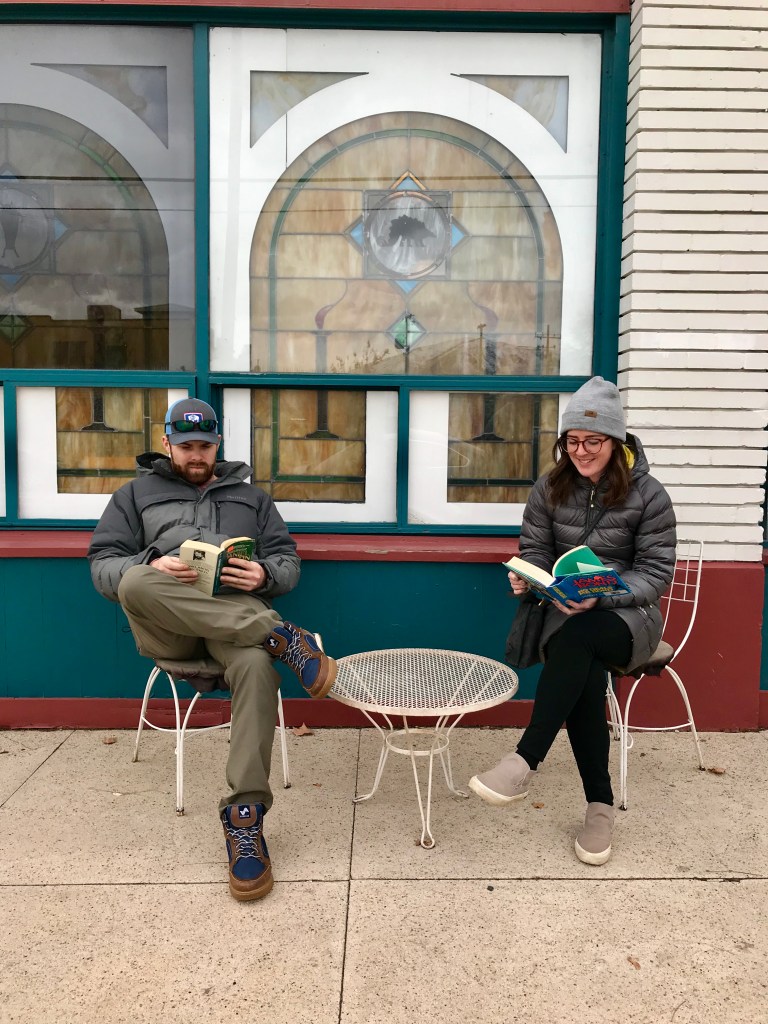
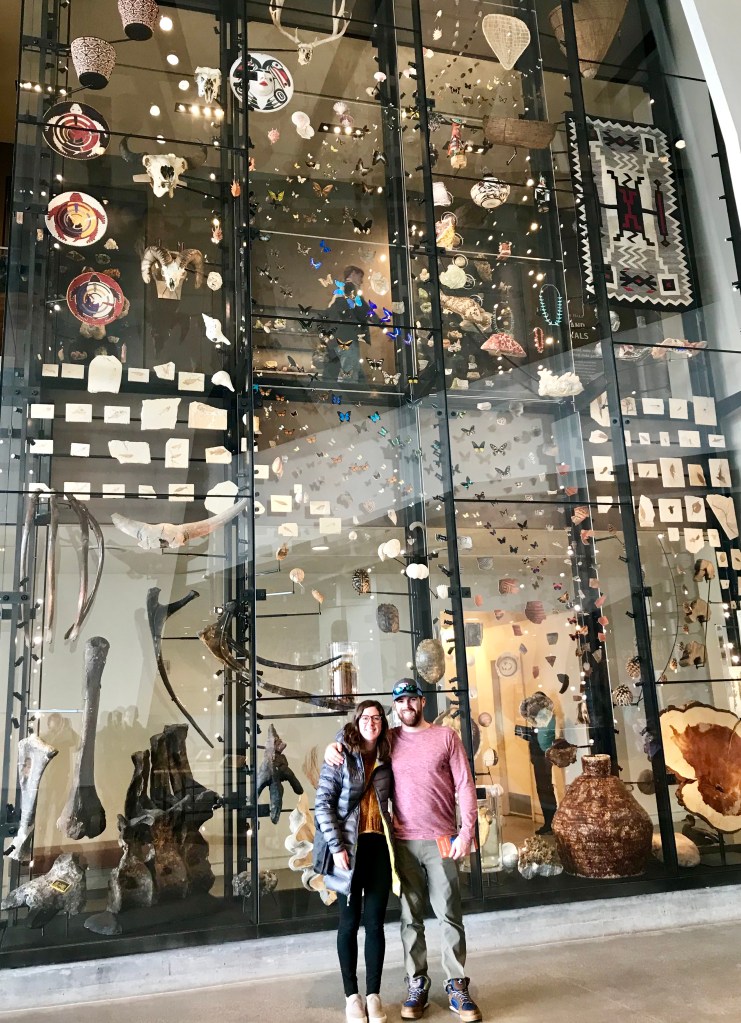
We spent the afternoon at Natural History Museum of Utah. It was all good. I said goodbye to Nora and Dan, and “I’ll see you on July 9th in Jackson, a few days before your wedding day.”
And then I woke up early, oh so early on that Sunday morning to drive down to UNLV to catch an 11 a.m. tennis match between UC Riverside and Colorado State. You see, my former students and high school tennis players at Peninsula High, Sara Khattab and Tia Elpusan, were now teammates at UCR, and I had yet to see them play as collegians. Sara was a junior and Tia a sophomore. They were CIF Doubles Champions and had helped Peninsula win a three straight (for Sara) and two straight (for Tia) California State Regional Team Championships. (They don’t have a state championship in tennis in California. But we had gone up to NorCal and wiped them out in The Golden State Classic.)
I thought I would surprise them, Sara and Tia. My plan was to watch them play and win, then quickly escort them over to the Flashlight for a quick picture.
I left at 5 a.m. and grabbed a coffee and drove through a light snowfall. Then I got tired, really tired. I pulled over—it was still dark—at a truck stop and took a ½ hour nap. When I awoke, I noticed an Oldenburg-esque form. Was I still dreaming? It was a reverse Oldenburg: a ferris wheelhad been shrunk to a miniature contraption.
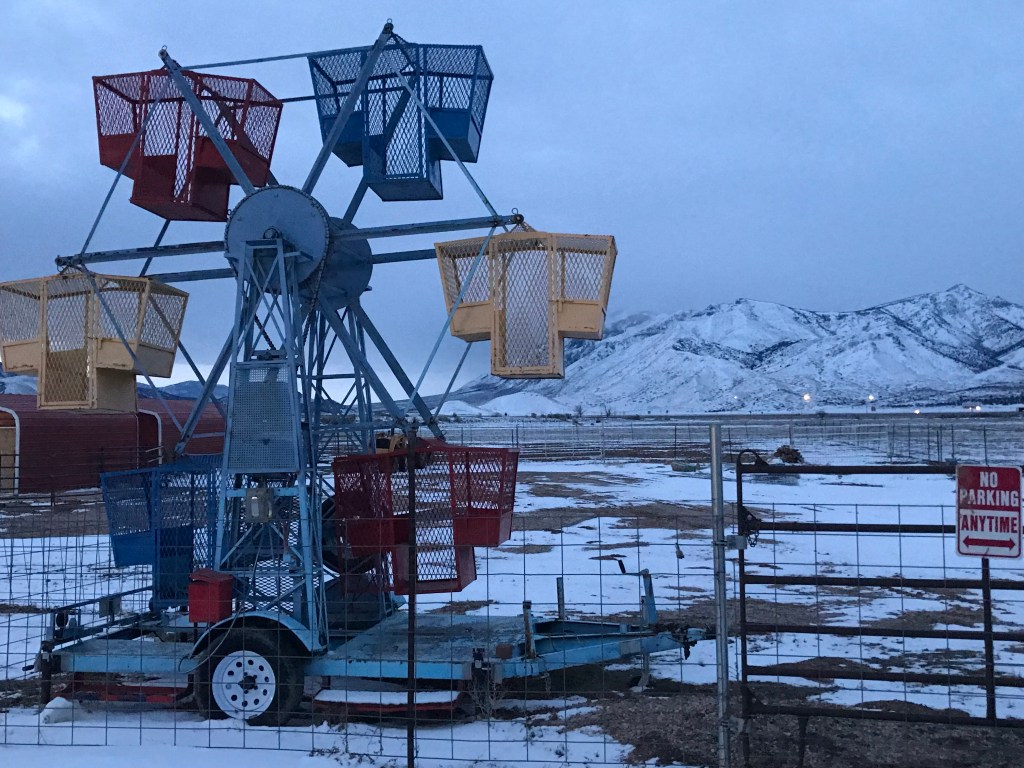
It was awesome. How did I not notice it even in the dark? It must be a sign. Maybe I would do the opposite of ClaesCoo sculptures? I would shrink pop monuments to still giant forms. I would be famous.
I drove with speed and purpose. The weather warmed. Would I make it to the match on time? I was a little late, but I made it. But now reality set in. The Flashlight was a ¼ mile away from the courts, not far but more towards the middle of campus. Sara and Tia were on a team, but not mine anymore. They had a coach, he was nice, but it was too awkward to ask. What would I say? “After the match, can I yank Sara and Tia over to this sculpture to take their picture? Just for a few minutes?” Weird. How could I justify. “I am writing a book on Claes Oldenburg, and …” But I am not writing a book—not yet (Do you know any literary agents?).
We chatted for a few minutes in-between their doubles and singles matches. It was pleasant, but I was socially off my game. Then I said I had to leave before traffic on a Sunday between Sin City and L.A. got nightmarish. That was true. But I was a little sad. I took a few pictures of them playing before I left.
Sara Khattab is about the nicest person on earth. Everyone likes her. Her laugh is infectious and her generosity enervating. She was in my English class as well as a starter for our tennis team for four years. She can serve and volley as well as Taylor Townsend. If college coaches only valued doubles players as much as singles players, she’d have been at a top 10 tennis school. But she’s happy at UCR, and I predict will be a doctor someday.
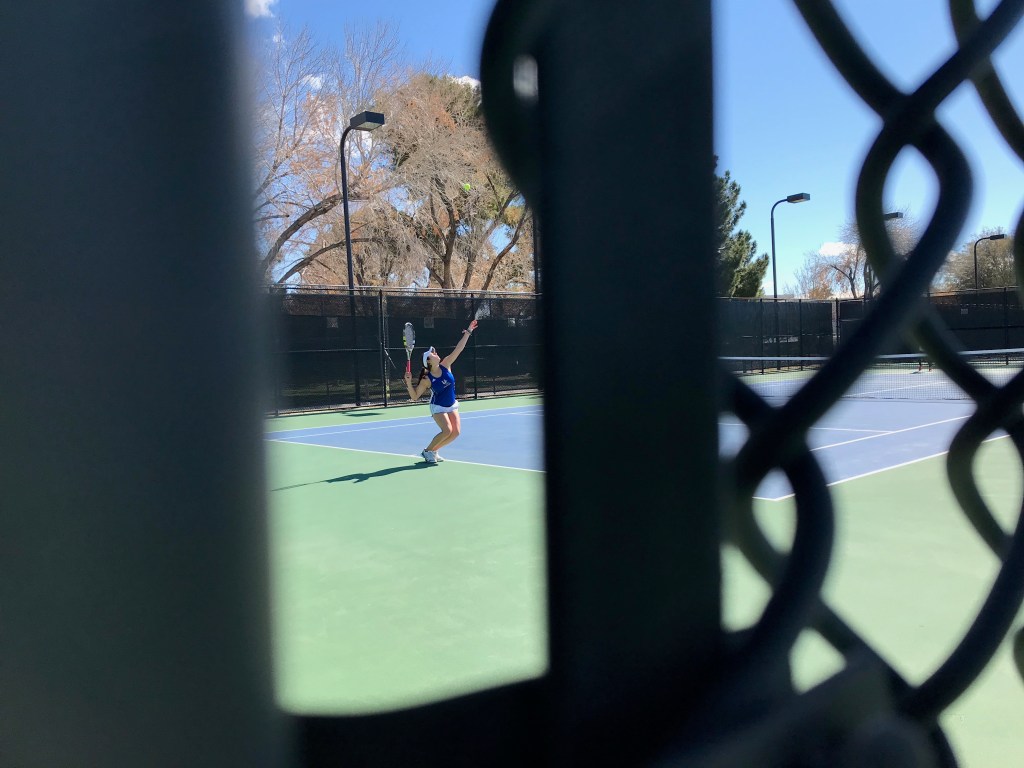
Tia Elpusan has a twin sister, Eman. Their father lost his fight with cancer when they were in middle school. Tia quit tennis. She picked it up again in high school and regained her early form. She takes every ball on the rise and has the most phenomenal timing. The family didn’t have the money to play tournaments. It is possible the UCR coach thought he was doing her a favor by taking her on the team without a ranking. But Sara must have told him that she can play. Tia now plays number one for UCR. Tia is also super nice, more on the quiet side, but don’t mess with her on the court. If she thinks you are cheating her, she’ll strike a pose and give you that stare. I captured it in this picture.
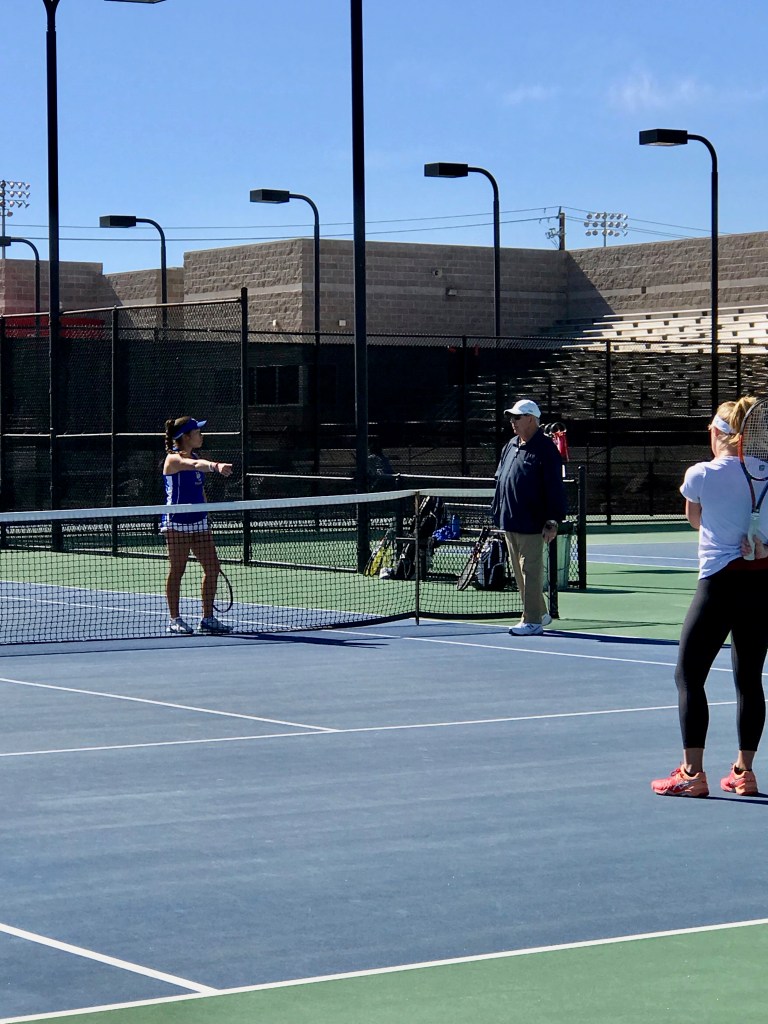
This was a story of how Sara and Tia and I almost met up at the Flashlight sculpture.
I have had some bad luck viewing the Flashlight. But that’s Vegas.
Wryly, but truly,
LV
 Claes, Coosje and Me
Leave a comment